|
When I think about US-27, I envision a two-lane road like this 1955 photo of US-27 in Clare County (photo courtesy Ron Wilbanks). |
(Well, OK... it's been renamed. It's now US-127.)
News Release: January 14, 2002
US-27 Vanishes from Michigan Highways
As a way to reduce confusion along the US-27/US-127 corridor, the entire corridor will now be known as US-127, the Michigan Department of Transportation announced. Starting in the spring of 2002, crews will begin replacing all US-27 signs north of Lansing to where it meets I-75 just north of Higgins Lake, and along the business routes. All signs are expected to be converted to US-127 by the fall of 2002.
Contact: 517-780-7510
NOTE: Craig Parrish is working with federal and state authorities to have old US-27 (from Michigan to Florida) designated as a US Historic Road. More news about this as it gets closer to becoming reality.
Craig's latest update (1-23-08)... "I met last week with State Representative Joan Bauer of Lansing. She is going to be the lead for the approval of making Old US-27 an historical road in Michigan. I finally have all the signatures needed. She will write the bill soon. I am told there is no opposition from either side. I am also told that the road will be official by the our tour in August 2008! Stay tuned! I am now talking to Gaylord and Houghton Lake about joining our tour. We'll see what happens."
![]() |
![]() |
Specific to Michigan US-27
|
| 1926 First design |
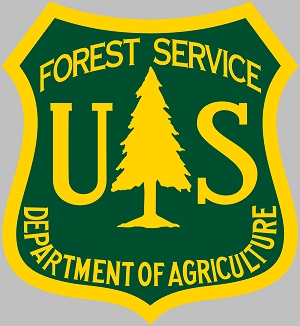
Using US Department of Agriculture's 1905 logo as a model (sample at left), Frank Cnare of Wisconsin State Highway Department submits design for US route marker (shield); Cnare's design becomes national standard.
|
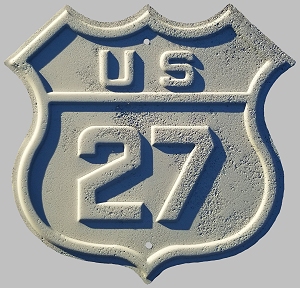
| 1926-1930 Cast iron Standard size |
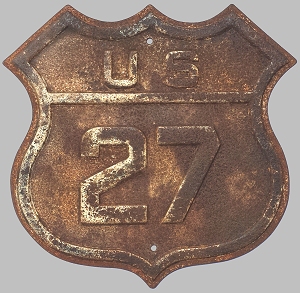
First US route markers in Michigan are made from cast iron, 16"x16", about ½"-1" thick, and weigh a hefty 13 pounds! Made from molten iron poured into mold then cooled by electric fans. Signs are so heavy, often fall off wooden posts on which they are mounted. 16"x16" becomes "standard" size.
|
| 1930 Embossed steel |
Michigan State Highway Department joins growing national trend and switches to embossed steel for all signage; easier than cast iron to mass produce and mount. Michigan also starts using 11"x11" shield (cast iron or embossed steel) with embossed border and numerals, but no state name across top. Used for downtown areas where speeds are slower. |
| Late 1930s 24"x24" introduced |
Larger embossed steel shields (24"x24") used at junction assemblies, turns, and where greater visibility is needed to direct motorists. Weigh 9 pounds! |
| World War II Wooden signs |
Due to shortage of steel, signs are made of plywood. Numerals are painted, not embossed. State saves money and materials for War effort. Signs are repainted as needed. Embossed steel sign production resumes after Japan surrenders. |
| 1948 Reflective sheeting |
Die-cut reflective sheeting material Scotchlite®, made by 3M, replaces embossed steel. Michigan uses remaining steel stock, but without embossment, thus thousands of flat steel die-cut signs are made with Scotchlite®. |
| 1951 Aluminum |
Michigan switches from die-cut steel to flat aluminum sheeting with reflective sheeting.
|
| 1952 MMUTCD |
Disgruntled employee sets fire to Michigan State Highway Department building in Lansing, resulting in spectacular five-alarm fire; destroys building and all contents; leads to creation of 1952 Michigan Manual of Uniform Traffic Control Devices (MMUTCD) and establishes standard for evolution of modern reflective signage across state for next 11 years. |
| 1956 36"x36" introduced |
Michigan State Highway Department starts using 36"x36" US route makers on interstate and divided highways. Used well into late 1970s on US-27 north of Lansing; last ones removed in early 1990s. |
| 1963 24"x24" new standard size |
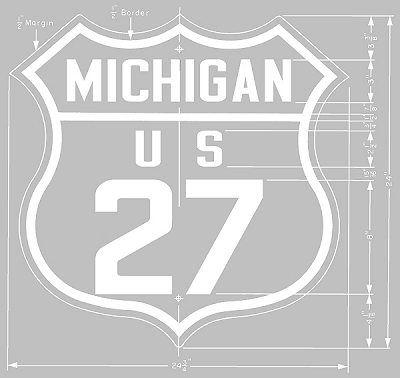
MMUTCD recommends 24"x24" as standard size for 2-digit US route markers. Larger 36"x36" and 42"x36" size shields without state name now used, especially at junctions, and where greater visibility is needed by motorists. |
| 1973 Rectangular |
Michigan begins to slowly replace die-cut aluminum with rectangular shields, painted with shield image and larger numerals. |
|
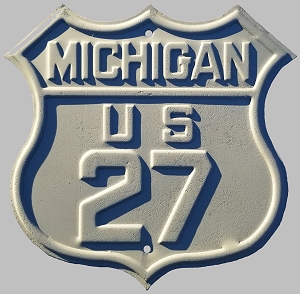
1930s Replica - This 16"x16" embossed steel shield was manufactured to 1930s federal standards using original dies and heavy-gauge steel.
This sign is for sale. Great memorabilia for your den or office. $50... includes shipping. Email me. |
|
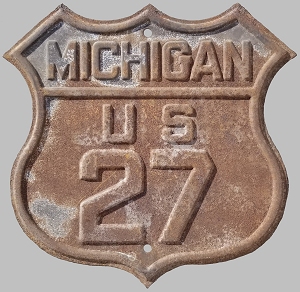
1930s - Both these embossed steel shields are owned by Robert Edgar in California. I would love to own one of these originals, but the cost is out of my league. If you have one of these originals and wish to sell it, please email me. |
|
|
|
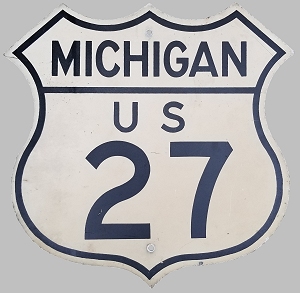
1950s - 24"x24", heavy-gauge, fully reflectorized aluminum (with a much lesser-quality reflective material than is used today). |
|
1970s - According to transportation historian Ron Wilbanks, "...this was from a 'Big Green Sign,' probably used as part of a 'trailblazer assembly.'" The metal is quite thin. 10 small holes around edge where it appears to have once been pop-riveted to a larger, more permanent sign. 24"x24", fully reflectorized, "27" is painted. |
| 1970s - One of many replaced in Summer 2002 when US-27 was renamed US-127 by MDOT. 24"x24" (the separate "NORTH" sign is 24"x12"). The numerals "27" and the letters "NORTH" are baked-on adhesive decals... all other portions in black are painted. Both signs are fully reflectorized with modern, very high visibility material. This sign actually started out as a Route 77 sign somewhere. You can faintly see the image of "77" upside down within the "27." |
|
We lived east of US-27 on Marshall Road (five miles north of St Johns) from 1946 to 1960 when I left home for the military. Growing up along US-27, we had a hard time crossing it when deer season started... just too much traffic. Went to a lot of places via US-27 for a lot of years. Had a sailboat slipped at Lake Charlevoix for a number of years and that was THE way to get there.
My sister informed me that John Baird's farm covered the area where US-27 would later be built (White Road between the towns of Wolverine and Indian River). That portion of his farmland was bought for the
road's right-of-way, but they wanted to start construction before they actually paid
Baird. So when the construction crew arrived to start building the road, my great-grandfather was at his property line with shotgun in hand. That's all she said, so
I guess that he got paid before construction started.
My Dad took my Mom and me on a trip up north in 1967, and during a stay in
Indian River, we were at a restaurant I believe it was. I recall a map of
Cheboygan County on the wall showing old US-27 marked as US-27, even
though I-75 was also shown. It looked like the kind of map that is published
by the Department of Natural Resources (was the Michigan Conservation Department in 1967).
Maybe someone in the printing room was nostalgic for US-27. While on that
same trip, I remember seeing a 1950s vintage "Speed Limit 65" sign as you
drove north out of Indian River on old US-27.
Your page brings back memories. I grew up in Traverse City and Alpena
and went to MSU in East Lansing. US-27 was one of the main routes from
Lansing to the north. Many times my dad or I drove from Lansing north
on US-27 to Grayling, then east on M-72 to Alpena.
The preservation of US-27 in Michigan would not be complete without mentioning some places along or near the route. In Clare, which calls itself the "Gateway to the North," one will find the Doherty Motor Hotel on the northeast corner of Clare's main intersection (now BUS US-127 / BUS US-10). It opened in April 1924, and was named after it owner Senator Alfred James Doherty. Originally the hotel was also home to the Clare Public Library on the ground floor, and a soda fountain shop, barbershop, and a coffee shop, to name a few things. It still has a nice restaurant. One event at the Doherty that made headlines throughout Michigan happened in May 1938 when oil promoter Carl Livingston shot and killed Isaiah Leebove in the hotel's Tap Room. Another icon of US-27's heyday was a commercial zoo run by a mountain man type named John "Spikehorn" Meyers. It was located at the corner of US-27 and the South M-61 junction. Meyers
ran his zoo from the 1930s until he passed away in 1959 at 89, and one of his favorite features were the black bears he had. Sadly, the zoo closed and fell in ruins after his death. Finally, a personal icon for me is located a short drive off US-27 near the Sturgeon River between Wolverine and Indian River. It is the farmhouse that belonged to my great-grandfather John Baird. Born in Canada, his mother Bridget brought the family to Michigan after her husband passed away in 1874. John Baird became a prominent Michigan politican from Zilwaukee, being elected township supervisor, state representative, state senator, delegate to the 1908 Michigan Constitutional Convention, and the first head of the Michigan Conservation Department (now the Department of Natural Resources). The farm also included a cabin on the property that John would use. The farmhouse is still in the Baird family.
In all the years I have been a passenger in a car, or driven myself, the only stretch of US-27 I have yet to travel is from the Indiana border to Charlotte, MI. This past weekend, I drove old US-27 from Dewitt to Clare while heading back from the MSU football game. I noticed there was a 1950s vintage "Pass With Care" sign at Sheperd in the southbound direction. I also drove US-27 this past summer from Grayling to Mackinaw City. There is another small piece of Old US-27 in Cheboygan County along Mullett Lake.
I applaud everyone's efforts in making old US-27 an Historic Route. The news just broke locally and I couldn't be happier. I have fond memories of traveling this highway as a child before I-69 opened. It is still my road of choice when traveling north and south. I would like to be included in your email list to receive updates on the progress of the project.
Thanks again for everyone's efforts.
US-27 was an old friend to us, having been the main thoroughfare through DeWitt Township (just north of Lansing). We even lived on US-27 for about six years. It had fond memories for us of when we were young going "up north" to Houghton Lake and traveling US-27 the whole way! I don't care what they call it now, or how many new businesses build on it, it will ALWAYS be "27" to us! When we go for gas, we go to the gas station "up on 27." When we get groceries, we go to the store "up on 27." When we speak of the new US-127, we call it "the highway," as in "there was a bad crash out on the highway today." Everyone knows what you're talking about. US-127 and I-69 are intrusions in our little neck of the woods, a necessary evil that was thrown upon us. We didn't have a say in it. Old "27" was like an old blanket... warm, familiar and comfortable with wonderful memories that will be cherished for all time. Thank you for paying homage to this wonderful piece of history. People like you will keep it alive in memory for those of us who love it and respect it and you will inform those who are too young to remember it. Keep up the good work, and we who live along it, by it and around it will never forget how it served us well in the past, and will continue to do so well into the future... no matter what it is called.
My wife and I have traveled parts of US-27 over the years, but this time we will be doing the route from Florida to Michigan, on purpose.
I-75 has become boring, tedious, long, and not even interesting anymore. We travel by the two-lane whenever we can, including to CA and back. This time we are taking a four-day trip to our home state, Michigan (Kalamazoo), via US-27. I enjoyed your web-pages and the write-up you have started. Some I printed off, and will be on our trip agenda.
We will start at Perry, FL, where US-19 joins in, and going on the original US-27 route as far as possible, knowing the route will follow the Interstates, especially through the cities. The route will end in Ft. Wayne, IN, then we will end up in Detroit.
This trip will take place in May 2008.
-Larry and Darlene Goodman of Lecanto, FL (Florida Non-Snow-Travelers)
- R J Baker of Hohenwald, TN (4/25/07)
- Thomas Baird of Traverse City, MI (3/19/07)
- Thomas Baird of Traverse City, MI (1/30/07)
- Dave Filpus, Chapel Hill, NC (12/19/06)
- Thomas Baird of Traverse City, MI (12/6/06)
- Thomas Baird of Traverse City, MI (11/13/06)
- Seth Downs of Coldwater, MI (9/8/2006)
- Vicky Lietzke of DeWitt, MI (6/15/2006)
|
|
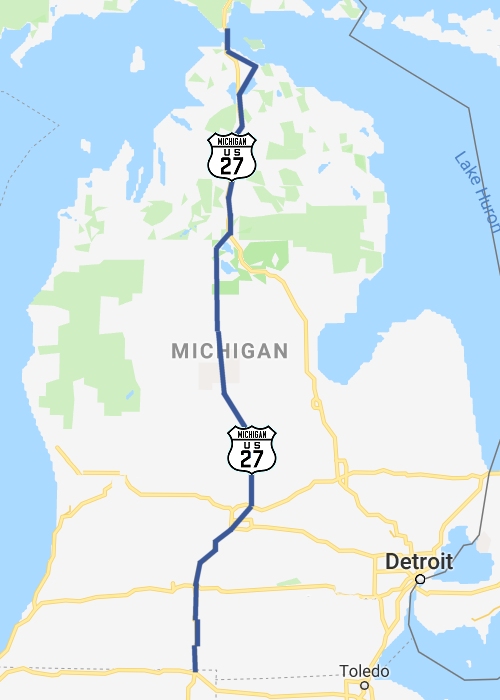
The last segment of US-27 in Michigan appeared between Lansing and I-75 north of Higgins Lake. It became US-127 in Fall 2002. |
||
| Alphabetically:
Alma |
Geographically (north to south): St. Ignace |
|||
My thanks to Dale Sanderson for these great maps.